The Show, Don’t Tell Junk Drawer
The Show, Don’t Tell Junk Drawer: Why Your Story Feels Messy
If you’ve spent five minutes in a writing workshop or a Facebook group, you’ve heard the command: "Show, Don’t Tell."
It’s the most famous rule in writing. It’s also the most misunderstood.
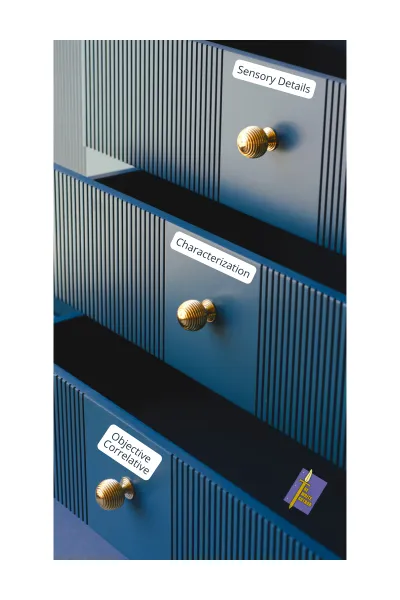
Over the last twenty years, "Show, Don’t Tell" has become the industry’s junk drawer. We’ve taken every distinct tool of the craft—Sensory Details, Characterization, Pacing, and Emotional Resonance—and we’ve swept them all into one messy bin.
When everything is labeled "Showing," nothing is clear.
The Anatomy of the Junk Drawer
When a writer is told to "show more," they usually reach into the junk drawer and pull out the first thing they touch. Usually, it’s one of these three distinct tools masquerading as the same rule:
1. Sensory Details (The Stage) These are the sights, smells, and sounds that ground the reader.
The Detail: The smell of floor wax and the high-pitched creak of a floorboard.
The Goal: Atmospherics. You are building a physical world so the reader doesn't feel like they are floating in a vacuum.
2. Characterization (The Evidence) This is using action to prove a personality trait.
The Action: A character biting their nails or checking the door lock three times.
The Goal: Characterization. You are proving to the reader who this person is through their habits.
3. The Objective Correlative (The Impact) While modern advice uses "Show, Don't Tell" to describe everything from the floorboards to the fingernails, this is the "Show" that T.S. Eliot and Chekhov actually cared about. It’s finding the specific object or situation that serves as a formula for a particular emotion.
The Moment: Reaching for a light switch in a dark house, only to remember the power was cut months ago. The "empty click" is the grief.
The Goal: Emotional Resonance. You aren't just describing a room; you are transferring a feeling directly into the reader’s chest.
Why the Dividers Matter
When you lump these together, you lose your ability to self-edit.
If a scene feels "off," you need to know which tool to grab. If the reader is confused about where they are, you don't need more "emotional resonance"—you need Sensory Details. If the reader is bored because the character feels like a cardboard cutout, you need Characterization. But if the reader is detached and doesn't care what happens next, you need the Objective Correlative.
Stop Digging, Start Forging
If you're struggling with Show Don't Tell, it isn't you. It's the advice that's been rattling around cluttering the craft drawer. You don't need more generic slogans; you need to understand the physics of your story.
You can spend time trying to sort through the junk on your own, or you can bring in a specialist to perform a Forensic Audit and identify exactly where the connection is failing. Either way, the "Show, Don't Tell" catch-all has to go.
It’s time to stop digging through the clutter and start using your tools with intent.
Forge ahead, wordsmith!
Stop digging through the junk drawer. Join The Writers' Forge today to get the diagnostic tools and real-time support you need to bring your story to life and connect with your readers.
Don't miss out on my next blog! Subscribe to my email list.